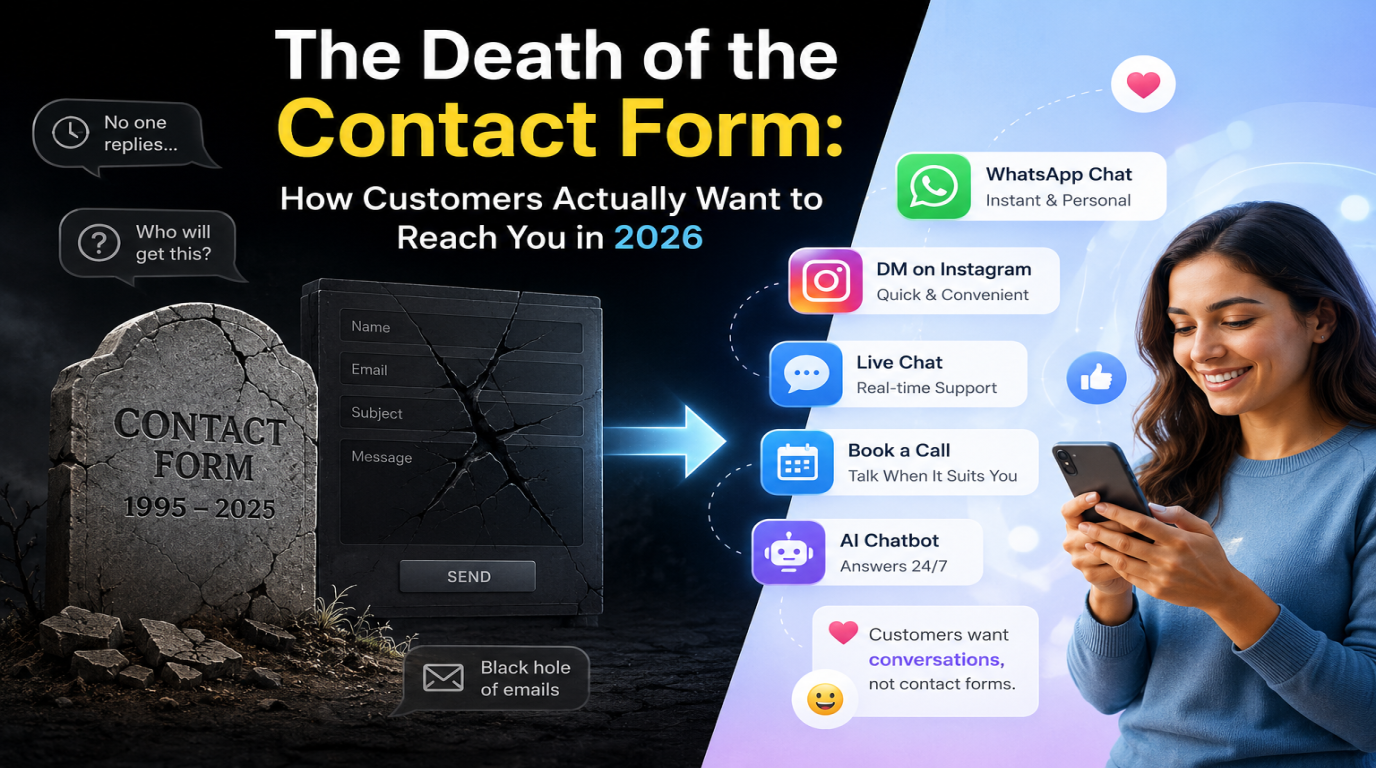
Quick question. When was the last time you personally filled out a contact form on a website? Not a checkout form. Not a login. A real "get in touch with us" form.
For most people, the honest answer is "I cannot remember." And yet almost every business website still has one sitting there, front and center, like it is 2012.
Meanwhile, potential customers are visiting your site, wanting to reach you, and quietly bouncing off because you are only offering them a way to talk that nobody uses anymore.
The contact form is not quite dead. But it is fading fast. And if your website is still built around one, you are probably losing more leads than you realize. Let me walk you through what actually changed, why customers hate contact forms now, and what they are using instead in 2026.
Why Customers Stopped Filling Out Contact Forms
There are a few reasons. Some are practical. Some are emotional. All of them are real.
It feels like shouting into a black hole
You fill out a form. You hit submit. You get a generic "thanks, we will be in touch" message. And then what? You wait. You hope. You do not know if your message actually went anywhere. You do not know if you will get a reply today, tomorrow, or ever.
Meanwhile, you can text your friend and get a reply in 20 seconds. Customers today expect fast, visible, back and forth communication. A form gives them the opposite.
Half the time, forms are actually broken
This is the ugly truth. A huge percentage of contact forms on small business websites do not work properly. Either the emails go to spam. Or the notification goes to an old email address nobody checks anymore. Or the form has a technical issue and the message never sends at all.
I have personally seen businesses go months without realizing their contact form was broken. They just thought their website was not generating leads. Turns out it was. They just were not receiving them. If your form emails are landing in spam, our piece on why business emails land in spam is worth ten minutes of your time.
Nobody wants to give their info to strangers
Customers have been burned too many times. Fill out a form, get spammed for years. Fill out a form, end up on someone's newsletter list you never signed up for. Fill out a form, get a robocall the next day.
People are protective of their information now. Giving up their name, email, and phone number to a company they do not fully trust yet feels risky.
It is the slowest option available
Even if your form works perfectly, it is still the slowest way for a customer to get an answer. They fill it out. Wait for someone on your team to see it. Wait for a reply. Reply back. Wait again. That whole process could have been a 3 minute chat, a text message, or a WhatsApp conversation.
What Customers Actually Prefer in 2026
Here is what has replaced the contact form. Some of these have been around a while. Some are newer. All of them beat the form in almost every case.
1. Direct messaging on platforms they already use
WhatsApp, Instagram DMs, Facebook Messenger. Customers are already logged in. Already comfortable. Already messaging their friends there. Adding your business to that same conversation feels natural.
WhatsApp Business has exploded in Canada and everywhere else. Small businesses that put a WhatsApp button on their website are seeing conversation rates two to three times higher than contact forms.
2. SMS and text messages
Text messaging beats email in every way that matters. Faster to send. Faster to read. Higher response rates. Feels personal, not corporate.
Services like Podium, Textline, and even free options let you add a "text us" button to your website. Customers tap it. It opens their phone's messaging app. They send you a text. You reply. Done. The average response time expected from a text is under 5 minutes. Compare that to email, which people expect a reply from within a day.
3. Live chat (with a real human)
Not chatbots pretending to be humans. Actual humans available to answer questions during business hours. When done right, this converts better than almost anything else on your website.
The trick is honesty. If a real person will reply in under 5 minutes, say so. If you use it as a message inbox, say that too. What kills chat is when customers expect an instant reply and get one three days later.
4. Booking directly on your site
For a huge number of businesses, the customer's real question is not "can you help me." It is "when can we talk." Instead of a contact form, offer them your calendar. Let them pick a time. Done.
Tools like Calendly, Cal.com, and Acuity have made this ridiculously easy. Add a button. Sync your calendar. Customer books a call. You show up. No back and forth needed.
5. AI chat assistants (when actually useful)
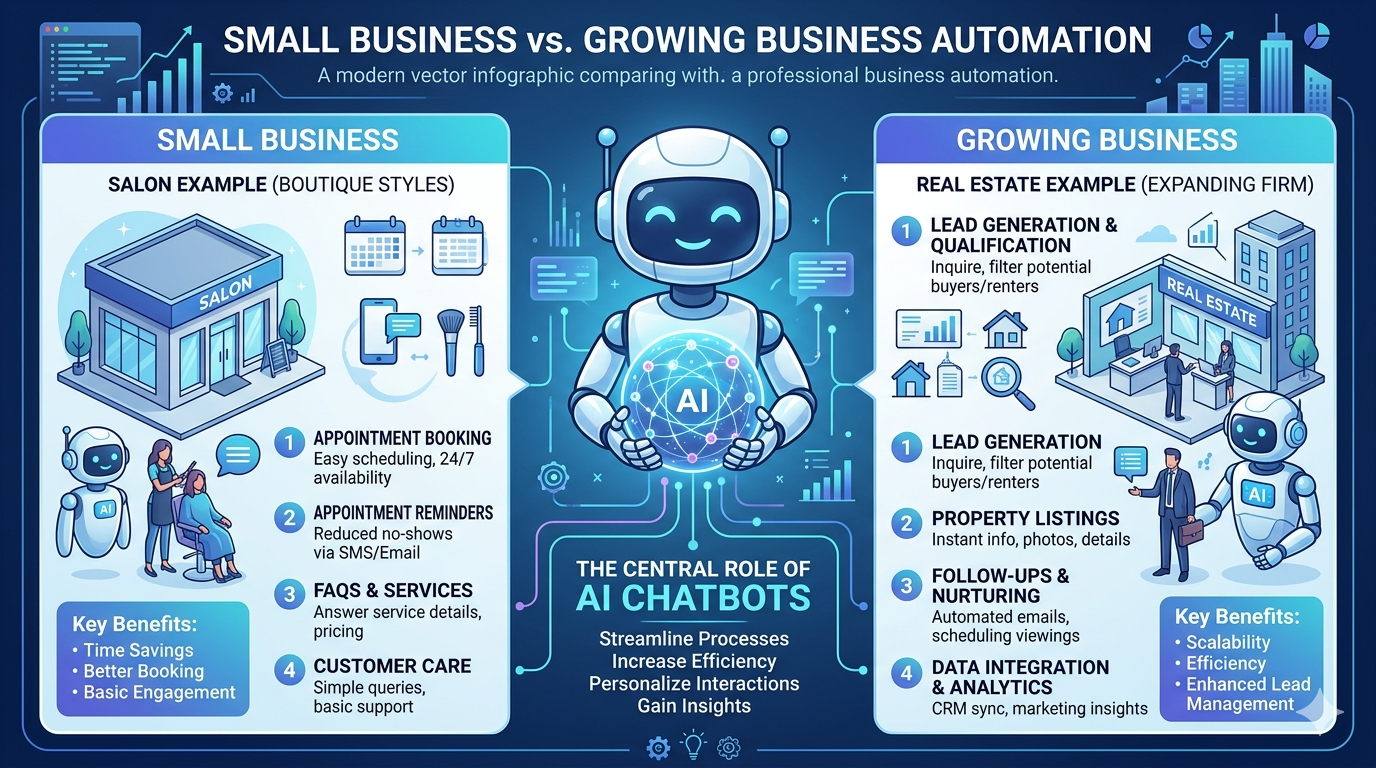
Not the sad little chatbots from five years ago that only answered "hi" with "hello." The new generation of AI chat is genuinely useful. Trained on your business. Can answer real questions. Can qualify leads. Can even book meetings.
For non-tech businesses, tools like Intercom, Tidio, and simple AI-powered widgets can handle the boring stuff so your team only sees the serious inquiries. Just do not hide from customers that it is AI. That backfires fast.
6. Click to call buttons
The oldest option on this list and still one of the most powerful. Especially on mobile. A "call now" button that opens the phone dialer with your number already in it. One tap and you are on the phone with them.
For local businesses like trades, restaurants, clinics, and shops, this often outperforms every other option.
What This Means For Your Business Website
If your site still has a contact form as the main way to reach you, you are probably losing leads. Here is what to do about it.
1. Offer multiple ways to reach you
Some customers want to text. Some want to call. Some want to email. Some want to book directly. The businesses winning in 2026 offer 3 or 4 of these options right on the same page. Not buried in a footer. Clearly visible.
2. Make the buttons obvious
Do not just put a phone number in text. Make it a big, tappable button. Same for WhatsApp, text, and booking. Customers on mobile need one tap options. Small links kill conversion.
3. Test your contact form right now
If you are keeping your contact form for the small group that still likes it, at least make sure it works. Send yourself a test message. See if it lands. Check if it goes to spam. Confirm the email address it is routed to is still active. You would be shocked how many broken forms I find during audits.
4. Reply fast or say you will not
Speed matters more than perfection. A 20 minute reply on WhatsApp beats a beautifully written email 3 days later. If you cannot reply fast, set expectations. An automated "we usually reply within 24 hours" is better than silence.
5. Use what customers already have
Do not force customers into new apps or accounts. Meet them where they already are. Most of your customers already have WhatsApp, SMS, and a phone dialer on their device. Use those instead of asking them to learn your custom form.
Quick Example
A local bakery had a contact form for cake orders. Big, complex, ten field form asking for cake size, flavor, delivery address, event date, dietary restrictions, and so on. They were getting maybe two form submissions a week.
They added a WhatsApp button. Customers started sending them photos of cakes they wanted, asking questions, changing their minds mid-conversation. Human, casual, back and forth.
Cake orders through the site tripled in a month. And the owner said the WhatsApp conversations were more fun to handle than the cold form submissions ever were.
The Bottom Line
Contact forms are not dead yet, but they are on the way out. Customers in 2026 want to reach you the same way they reach their friends. Fast. Casual. On platforms they already use.
If your website is still built around a form and nothing else, you are probably losing leads without knowing it. The fix is not complicated. Add a few better options. Make them easy to see. Reply quickly. Watch what happens.
Look at your website today. Really look at it. Count how many easy, obvious ways there are for a customer to start a conversation with you. If the answer is just one form, you know exactly what to do next. And if you are not sure where to start, this is one of the fastest, cheapest wins for almost any business website. A few hours of work. Massive lift in leads.
At Logic Providers, we help business owners turn their websites into proper lead generating tools. If yours feels like it is just sitting there, we can take an honest look and tell you what is holding it back.