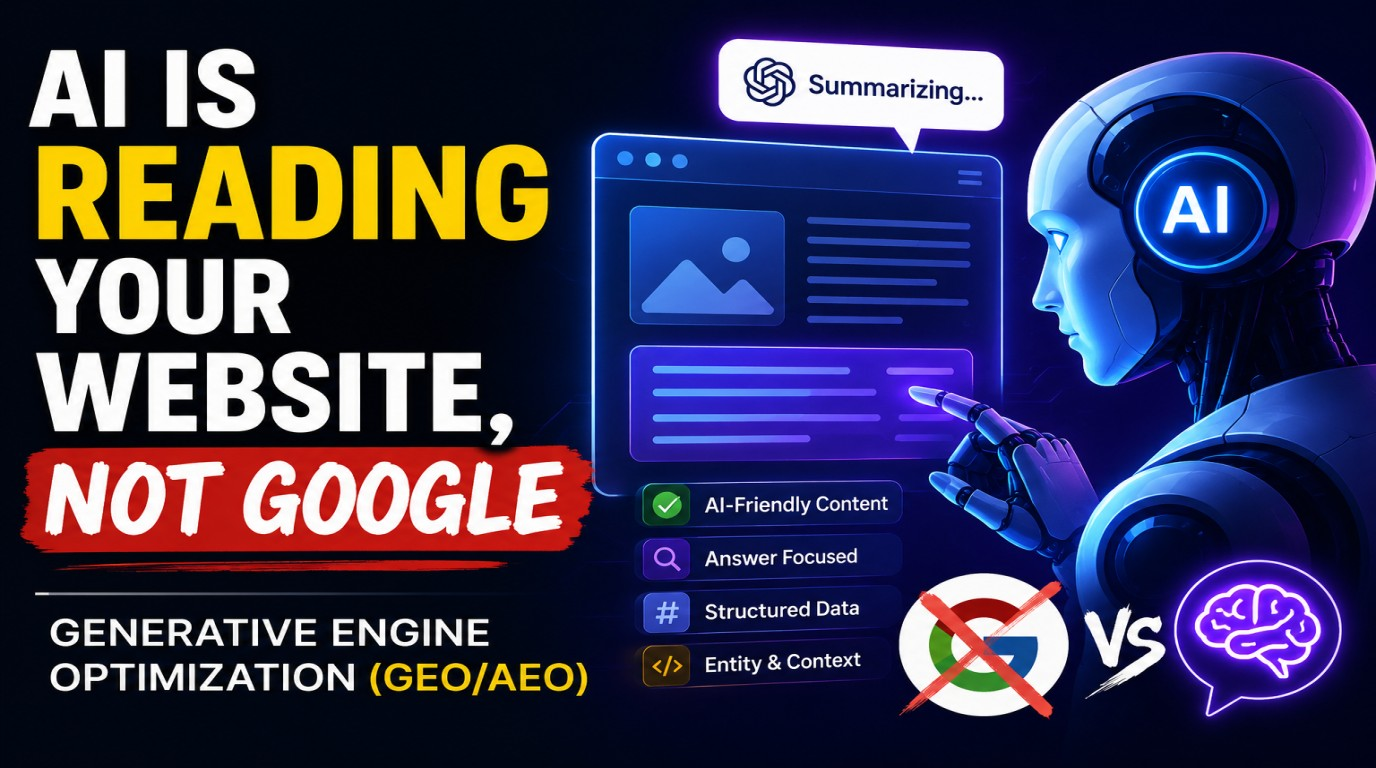
For twenty years, the goal was simple: rank on Google. You optimized for keywords, earned backlinks, fixed your page speed, and fought for a spot on page one. That game is not over, but it is quietly being replaced. A growing share of your customers never see a list of blue links at all. They ask an AI assistant a question, get one synthesized answer, and act on it. If your business is not inside that answer, you may as well not exist - no matter how well you rank.
This shift has a name, or rather two competing ones: Generative Engine Optimization (GEO) and Answer Engine Optimization (AEO). Both describe the same new job: making sure AI systems can read, understand, trust, and cite your business when they answer a question your customer asks.
What Actually Changed
Traditional search gave the user ten options and let them choose. An AI answer gives them one. That single difference rewrites the economics of being found.
On a Google results page, being at position four still earns clicks. In an AI answer, there is no position four. There is the answer, and there is everything the model decided not to mention. The traffic that used to trickle in from mid-page rankings simply evaporates, because the user got what they needed without ever visiting a site.
The second change is subtler and more important: the reader is now a machine. Your homepage was written to persuade a human being who is skimming. AI systems do not skim, they do not care about your hero image, and they are not moved by clever copy. They extract facts, match them to a question, and decide whether your page is a trustworthy source worth quoting.
GEO Is Not a Replacement for SEO
Let us kill the hype first. You will see people claim SEO is dead. It is not. AI systems still lean heavily on search indexes to find candidate sources, and they still weigh the same trust signals that traditional SEO cares about: is this site authoritative, is it technically sound, does it load, is it crawlable.
Good SEO is the entry ticket. GEO is what happens after you are in the room. If your site is slow, blocked, or thin, you will not get cited by an AI either - which is why the fundamentals of speed and performance still matter. GEO adds a new layer on top: being structured and quotable enough that a model can lift a clean, correct fact out of your page with confidence.
How AI Decides Who to Cite
Having watched how these systems behave, a few patterns show up consistently.
- It wants a direct answer, not a build-up. Pages that answer a question in the first two sentences get quoted. Pages that spend 400 words setting the scene get skipped.
- It rewards specificity. "We have served the Vancouver area since 2015 and specialize in Laravel and AI integrations" is extractable. "We deliver world-class solutions tailored to your needs" is noise to a machine.
- It trusts structure. Clear headings, question-shaped subheadings, lists, and tables let a model find the boundaries of a fact. A wall of text forces it to guess.
- It cross-checks. If your claim appears consistently across your site, your Google Business Profile, directories, and third-party mentions, confidence goes up. If your address or service list contradicts itself across the web, the model quietly discounts you.
- It needs to be allowed in. If your robots.txt blocks AI crawlers, or the content only renders after heavy client-side JavaScript, you are invisible before the contest starts.
What to Actually Do
None of this requires rebuilding your website. It requires writing and structuring it for a reader who is not human.
1. Answer the question first
Put the direct answer in the opening lines, then elaborate. This is the single highest-leverage change. It also happens to be better for human readers, who are equally impatient.
2. Write subheadings as real questions
People do not type "services". They ask "how much does a custom web app cost in Canada". Subheadings phrased as the actual question give the model a clean match between query and content.
3. Add structured data
Schema markup - Organization, LocalBusiness, Product, Article, and especially FAQPage - hands machines the facts in a format that removes all guesswork. FAQ schema is the cheapest, highest-return markup for AI answers.
4. Publish the specifics you have been hiding
Vague copy is a GEO liability. Publish real prices or ranges, real service areas, real timelines, real technologies, real team credentials. Every concrete fact is a hook the model can grab. Every vague sentence is unusable.
5. Build an FAQ that answers real questions
Not a marketing FAQ. Take the actual questions your sales team answers on calls every week and answer them plainly on the page. Those are precisely the queries customers type into an AI.
6. Make your facts consistent everywhere
Name, address, phone, services, and hours should match exactly across your site, Google Business Profile, and every directory. Contradictions cost you confidence.
7. Check that AI crawlers can reach you
Review robots.txt. Confirm your key content renders server-side and is present in the raw HTML, not only after JavaScript executes. If a crawler cannot see the text, it cannot cite the text.
How You Measure It (Awkwardly)
Honesty matters here: GEO measurement is genuinely immature. There is no Search Console for AI answers yet. What works today is unglamorous:
- Ask the major AI assistants the questions your customers ask, and see whether you appear. Repeat monthly and log it.
- Watch your server logs and analytics for AI crawler user-agents to confirm you are being read.
- Watch for referral traffic from AI tools - it is small today but growing, and it converts unusually well because the user arrives pre-qualified.
- Track the trend, not the vanity number. "Do we get mentioned for our five most valuable questions?" is the metric that matters.
The Uncomfortable Trade-Off
There is a real tension nobody likes to say out loud: succeeding at GEO can reduce your traffic. If an AI answers the customer's question using your content and cites you, the customer may never visit your site. You won the mention and lost the pageview.
That is not a reason to opt out - the alternative is a competitor being cited instead. But it does mean the scoreboard changes. Raw sessions become a weaker measure of marketing health. Being the source that AI trusts, and the brand the customer remembers when they are ready to buy, becomes the real prize. Plan for fewer, better visitors rather than more of them.
Where to Start
Pick your five most commercially valuable questions - the ones that come right before someone becomes a customer. Write a genuinely excellent, specific, directly-answered page for each. Add FAQ schema. Confirm crawlers can read it. Then ask the AI assistants those five questions once a month and watch what happens.
That is a week of work, not a rebuild. And it puts you ahead of the overwhelming majority of businesses who are still optimizing exclusively for a results page that fewer of their customers look at every month.
The search box did not disappear. It just started answering back. The businesses that adjust to being read by machines will be the ones those machines recommend.
At Logic Providers, we build and optimize websites for how customers actually find businesses now - including making sure AI systems can read, trust, and cite you. If you want an honest look at whether your site is visible to AI search, we are happy to take a look for free.